
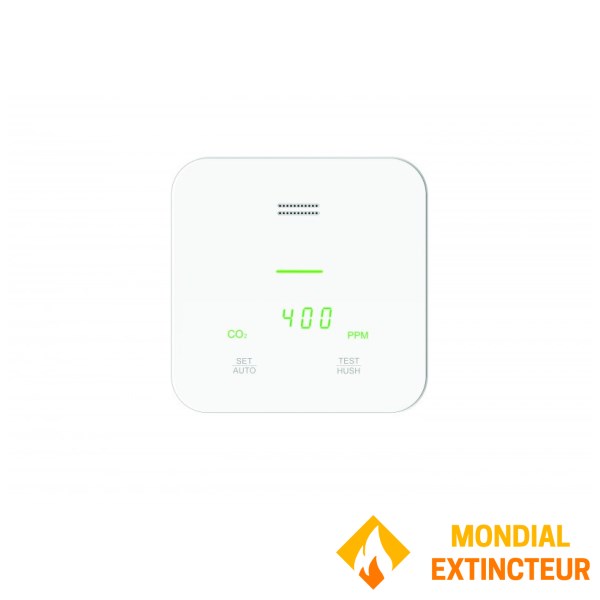
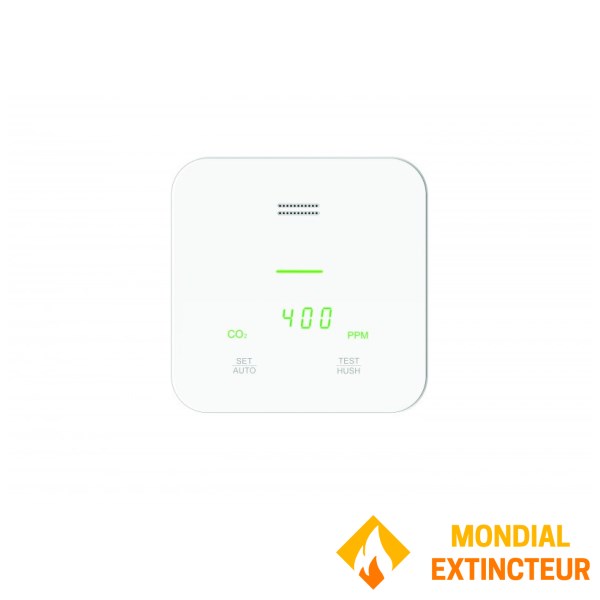
Carbon dioxide - Co² detector
Technical description Main
- Mounting: Wall-mounted or free-standing
- Autonomy: 12 hours
- Measurement range: 400 to 5000 ppm
- Accuracy 50 ppm
- Certifications: EN 50543-2011 AC-2014
- Weight: 291 g
- Dimensions: W.99 x H.99 x D.37 mm
How does our CO2 sensor measure the CO2 content of a room?
Equipped with a nDIR sensorour CO2 sensor measures the concentration of CO2 in the air in a room using a non-dispersive infrared techniquea reliable technique recommended by the government (Decree no. 2015-1926 of 30 December 2015 - article 8).
According to the national health protocol and the Haut Conseil de la Santé Publique, a room must be ventilated from 800 parts per million (ppm) of CO2 in the air. As an indication, a concentration of between 1000 and 1500 ppm in the air may lead to the evacuation of the premises while sufficient ventilation is carried out to restore CO2 levels to below 800 ppm. The CO2 sensor enables you to monitor this concentration data, to be alerted if the threshold is exceeded and to apply the appropriate measures (opening doors/windows, ventilation with an air purifier, etc.).
Above 800 ppm, our sensor is triggered and signals this measurement in several ways:
Audible alarm 75 dB
Spoken message
Visual alarm
So you know when it's time to change the air in the room and keep your enclosed spaces optimally ventilated.
Why install a CO2 sensor?
The national health protocol now recommends that measurements of carbon dioxide (CO2) in the air be taken at significant points in the frequentation area and during periods of high frequentation, particularly when the recommendations for natural ventilation cannot be complied with.Thanks to the research and scientific knowledge that professionals have been able to accumulate since the start of the pandemic, we now know how the Sars-Cov 2 virus (COVID-19) is transmitted: COVID-19 is transmitted mainly by air. It survives well and for a long time in the droplets that remain suspended in the air after talking, sneezing or coughing, for example. Hence the importance of airing rooms properly, especially closed rooms, to reduce the risk of viral contamination.
Where to install a CO2 sensor?
CO2 sensors have been put back on the agenda with the COVID-19 pandemic. On 22 April 2021, M. Blanquer, Minister for National Education, officially encouraged local authorities to install CO2 sensors " wherever relevant " in schools such as schoolsmore generally, today's national health protocol recommends the installation of a CO2 sensor at significant points of frequentation and at periods of high use, in particular when natural ventilation recommendations cannot be respected. This includes enclosed spaces, the companieseRP, ERT, catering facilities, etc.
How do I install a CO2 detector?
To obtain relevant measurements, the sensor should be placed at human height, away from any sources of disturbance and air renewal zones (windows, air conditioning, doors, etc.). Our CO2 detector can be portable, so it can be placed freely or mounted against a wall.
Click here for the national health protocol complete.
- Reference : DDCO2