RIP my fire extinguisher… or not!

Your fire extinguisher has been in service for some time and you are wondering whether it is time to send it into retirement… Sentimental after everything you have been through together, you would like to go a little further with it. But a tired fire extinguisher can no longer ensure your safety as it did on the first day… What should you do? How can you tell whether it is only good for use as a decoration or destined for the scrapheap? Is it possible to give it a second lease of life so as to extend its service life? These are questions that are not always easy to answer… So here is a summary of the key information you need to know on the subject.
The official regulations
Having equipment kept in good working order is a fundamental regulatory objective. It is indeed essential to be effectively protected, especially as the effectiveness of fire extinguishers depends on their proper maintenance.
The reference to consult on the subject is standard NFS 61-919. It distinguishes two types of check:
- Inspections, which can be carried out by the user.
- Maintenance, which must be carried out by a competent person.
Inspections are voluntary. They can be carried out every three months, but it is preferable to do them every month. During an inspection, the premises' staff or a qualified inspector checks the following points:
- All the units are in their designated place.
- They are fully accessible, clearly visible and in good external condition.
- Their instructions for use are displayed, legible and facing outwards.
- The pressure gauge needles are in the green zone (for fire extinguishers fitted with a pressure gauge).
- The safety seals on the pin are neither broken nor missing.
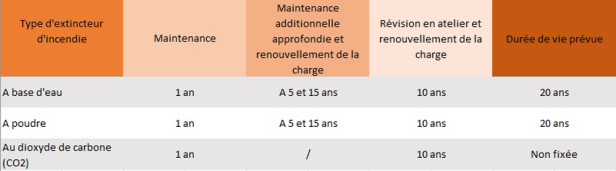
Maintenance must be carried out every year, with a tolerance of plus or minus two months, by a competent person. But what is meant by a "competent person", you may ask… It is a "person employed by a certified company or body and having the required training and experience"[1]. The training in question leads to the qualification of fire extinguisher inspection technician. Once the technician has completed the task, they must write "checked" and affix the date of the check on the fire extinguisher's label.
Apart from specific requirements, the servicing and maintenance frequencies are as follows:
What about recharging and overhaul?
Again according to standard NFS 61-919, fire extinguishers must be recharged, or even replaced, after use, whether partial or complete. The label of the fire extinguishers concerned must then be updated and bear the words "recharged" together with the date of the recharge.
The workshop overhaul, for its part, must be carried out in a workshop approved by one of the manufacturers and equipped with the appropriate equipment, personnel and documents. You can find information on this in annex D of the above-mentioned standard. However, this operation can be costly. It may therefore be more advantageous to buy a new fire extinguisher outright.
Various documents have also been written to guide users as well as possible:
- The APSAD R4 reference document published by the CNPP sets out the minimum maintenance requirements that fire extinguisher installations in industrial, commercial or service-sector buildings must meet. It can serve as a contractual basis between insurer and insured.
- The practical guide to the maintenance of portable, mobile and fixed fire extinguishers is a very good source of information.
In addition, it is always useful to take the following steps:
- Check that the fire extinguishers are still suited to the risks.
- Make sure that their location is still appropriate.
- Keep informed about new types of equipment arriving on the market.
Once you have met these obligations, it is important to record them properly in the safety register so that they can be tracked effectively.
[1] http://www.inrs.fr/media.html?refINRS=ED%206054